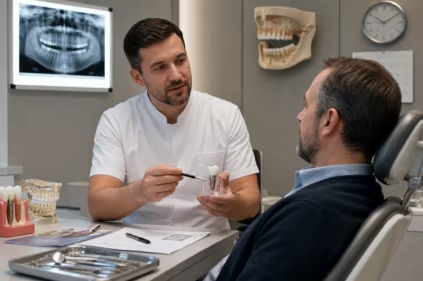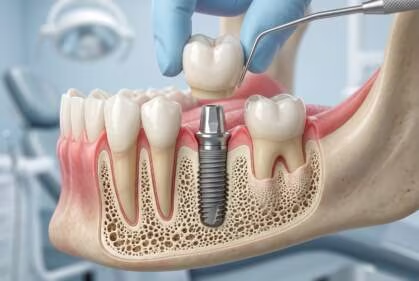
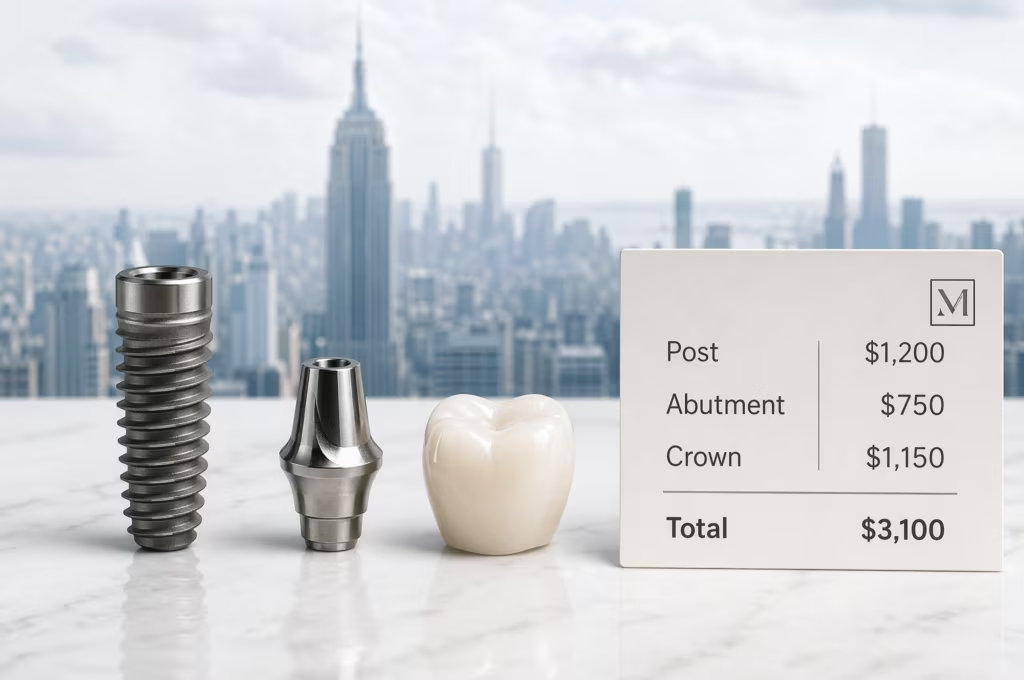
- Core Components: Titanium post, abutment, and custom crown
- Initial Exams: 3D imaging and surgical consultations
- Price Variations: Driven by surgeon expertise and clinic location
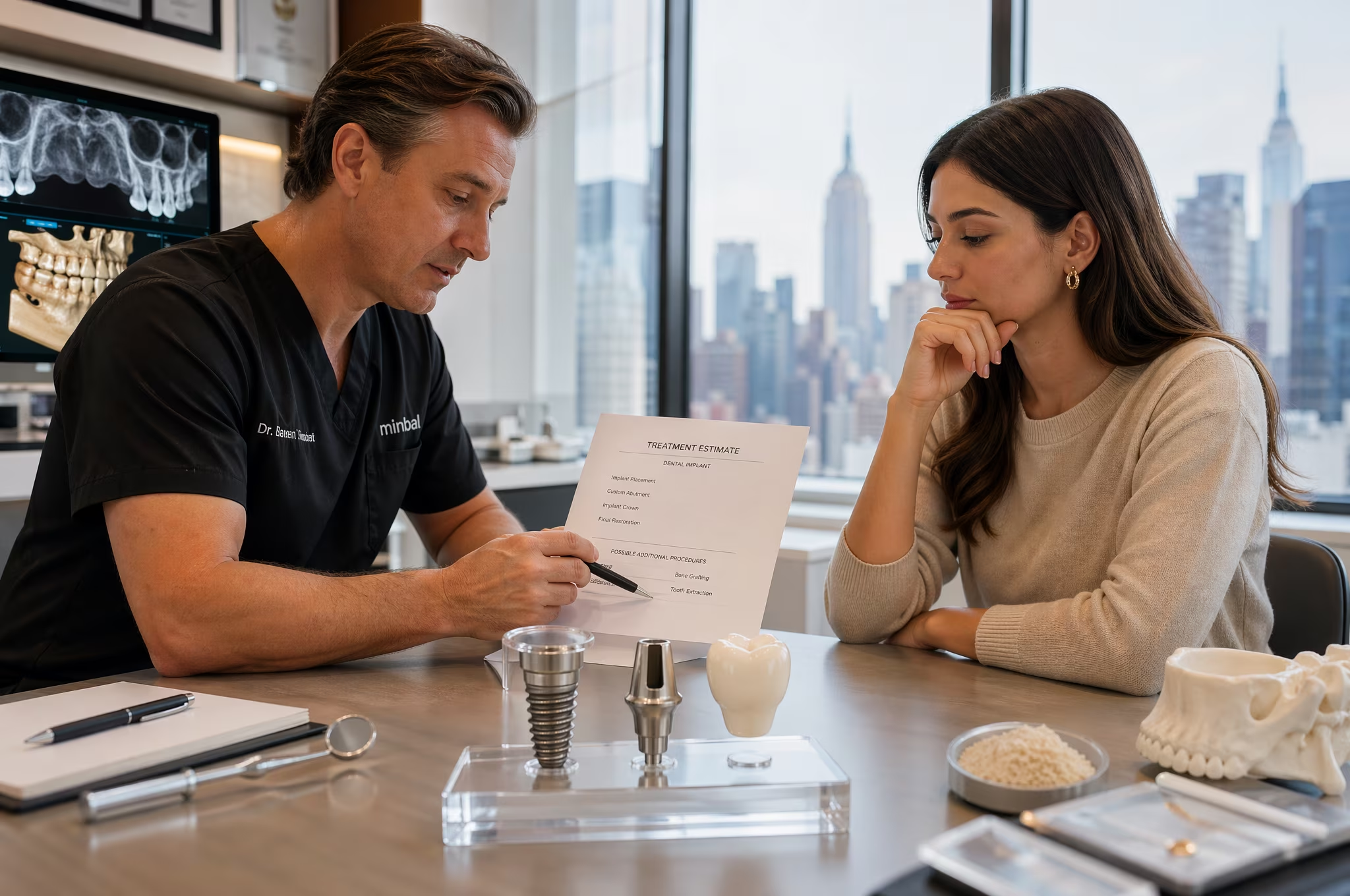
- Hidden Fees: Potential bone grafting or tooth extractions
A standard dental implant cost new york language test reveals prices include the titanium post, abutment, crown, and initial exams. Bundled quotes vary significantly across clinics due to material quality, surgeon expertise, and location. Understanding this pricing guide helps patients accurately compare the true cost per implant without hidden fees.
Contents:
- Single tooth vs full-arch implant costs in New York
- Why are Midtown Manhattan prices often higher than other New York areas?
- Which add-on procedures increase the final implant bill?
- How to compare implant quotes before you commit
- What do experts say about value and confidence?
- Are there legal rules or language requirements for implant treatment in New York?
- Implants vs bridges vs dentures: lifetime value comparison
- How financing and dental packages affect affordability
- Conclusion
Single tooth vs full-arch implant costs in New York
When researching the dental implant cost and procedure in New York , it is important to understand that prices vary significantly based on the complexity of the restoration. Below is a comparison of estimated price ranges for single tooth implants, All-on-4, All-on-6, and full-mouth solutions in 2025.
| Implant Solution | Estimated Price Range |
|---|---|
| Single tooth implant | $3,500 — $7,500 |
| All-on-4 (Per arch) | $15,000 — $31,000 |
| All-on-6 (Per arch) | $15,000 — $31,000 |
| Full-mouth (Both arches) | $30,000 — $62,000 |
Data source: Walden Dental NY — New York price ranges for single implants and full-arch solutions.
Why are Midtown Manhattan prices often higher than other New York areas?
Midtown Manhattan dental implant prices run dramatically higher than in the outer boroughs — and the reasons have nothing to do with better teeth and everything to do with commercial rent, specialist overhead, and the luxury-packaging arms race that central NYC clinics have locked themselves into. When a practice sits in the heart of Midtown, it’s absorbing some of the most punishing commercial real estate costs on the planet. Those costs don’t disappear — they land directly on patients, pushing a single implant far above what you’d pay in Astoria, the Bronx, or a solid chunk of Brooklyn. Knowing exactly why that gap exists is the difference between an informed decision and just chasing a lower number.
Specialist fees make the gap even wider. Oral surgeons, periodontists, and prosthodontists working in Midtown typically charge significantly more than their peers in less commercially dense neighborhoods. That’s not arbitrary — many have completed advanced fellowship training, maintain ties with nearby hospitals and research institutions, and operate clinics built around technology most patients have never heard of: cone-beam CT imaging, computer-guided implant placement, same-day provisional restorations. According to Midtown Dental Care, single implant pricing in Midtown NYC reflects precisely this local cost positioning — bundled plans covering diagnostics, surgery, and the final crown that regularly land well above national averages. No surprises there.
Packaging is where comparisons get genuinely tricky. A Midtown clinic will almost certainly bundle sedation, 3D imaging, bone grafting assessment, and extended aftercare into a single quoted figure. A Brooklyn dental office? It’ll often list those same items individually, making the opening quote look dramatically lower — even when the final bill ends up comparable. Always demand an itemized breakdown. Always. Without one, you’re comparing apples to blueprints. And once the surgery is done, understanding the dental implant healing stages specific to New York patients helps set realistic expectations about follow-up visits — which quietly add to the total cost in ways nobody warns you about upfront.
Then there’s the branding layer. Corporate dental groups and boutique cosmetic practices have colonized Midtown Manhattan, and they spend aggressively on interior design, concierge-style patient experience staff, and marketing campaigns you’ve probably already scrolled past three times this week. All of it gets embedded in treatment fees. A family-run Brooklyn practice operating in a lower-rent corridor doesn’t carry that overhead — which means it can offer genuinely competitive pricing without cutting corners on clinical quality. For anyone with schedule flexibility and no strong objection to a subway ride, exploring reputable providers outside the central business district remains one of the sharpest, most practical ways to reduce what you actually pay for implant treatment. The expertise follows the dentist, not the zip code.
Which add-on procedures increase the final implant bill?
Add-on procedures can silently double or triple your implant bill in New York — and most clinics won’t warn you upfront. A single-tooth implant gets quoted at $3,000–$7,500. Sounds manageable. But once bone grafts, sinus lifts, extractions, and temporary restorations enter the picture, that number can blow past $10,000–$15,000 before you’ve even had a screw placed. Patients don’t see it coming. Then they get the invoice.
Bone grafting hits first — and hits hard. Costs run $300 to $3,000 depending on how much material your jaw actually needs. If you’ve had a missing tooth for years, survived periodontal disease, or taken any trauma to the jaw, there’s a real chance you’ve lost bone density. No adequate bone, no stable implant. Full stop. Then there’s the sinus lift — required when the upper jaw lacks height near the sinus cavity — which tacks on another $1,500–$5,000. As the team at Babylon Dental Care makes clear, even outside Manhattan these add-ons routinely push a realistic single-tooth procedure to $3,000–$6,000. Skip these steps when your bone demands them? Implant failure rates climb to 10%, with revision costs starting at $5,000. That’s not a savings strategy — that’s a gamble.
Extractions and temporary restorations are the quiet killers of any «starting from» price. An extraction runs $300–$500 per tooth and almost never appears in the advertised number. Temporary crowns and provisional dentures worn across a dental implant recovery timeline of three to six months aren’t cosmetic extras — they protect the surgical site and keep your bite functional while osseointegration does its work. Mini dental implants occasionally get pitched as a lower-cost workaround, but they carry their own ancillary costs tied to bone structure and aesthetic requirements. Nothing is ever as simple as it’s advertised.
Manhattan and Midtown clinics are especially aggressive with «implant special» promotions that strip out bone augmentation and pre-surgical care entirely. Patients agree to what looks like a reasonable procedure. Then the real plan gets drawn up. Suddenly the invoice reads $20,000+. Suburban New York providers tend toward more inclusive package pricing — worth factoring into your search radius. Wherever you go, demand a fully itemized breakdown before signing anything: grafting materials, pre-op workup, post-op care, every line. A transparent treatment plan isn’t just good for your wallet. It’s the difference between a successful implant and an expensive do-over.
How to compare implant quotes before you commit
Before committing to a procedure, it is crucial to understand how dental implant surgery works and evaluate your options carefully. Use this practical checklist to compare your dental implant consultation experiences, review each treatment plan, and choose the right provider.
- Request an itemized quote from each clinic to ensure all costs, including the implant post, abutment, and crown, are clearly listed.
- Verify the credentials and experience of the oral surgeons, checking their specific training in implantology and patient success rates.
- Compare the proposed treatment plan from different providers to see if they recommend the same preliminary procedures, such as bone grafting or extractions.
- Ask directly about potential hidden fees, including costs for initial 3D scans, anesthesia, follow-up visits, or emergency appointments.
- Evaluate the overall quality of the dental implant consultation, noting how well the team answers your questions and explains the expected timeline.
What do experts say about value and confidence?
Dental implants are the gold standard of tooth replacement — and the reason patients choose them over cheaper options, despite the upfront cost, comes down to one word: confidence. Removable dentures slip. Bridges sacrifice healthy teeth. Implants do neither. They replicate the natural tooth from root to crown, and that biomechanical integrity is exactly why clinical consensus has held firm for decades — no other restorative option in modern dentistry matches the long-term predictability of a titanium-anchored implant.
Every serious consultation eventually circles back to the same two questions: how long will it last, and how will I feel? The psychological weight of tooth loss is almost always underestimated — by patients, and sometimes by practitioners too. People living with gaps, loose dentures, or a smile they hide in photographs report real declines in social engagement, professional presence, and daily quality of life. A permanent, stable tooth changes that entirely. Specialists at Smileworks NYC put it plainly: implants deliver confidence benefits that extend far beyond the clinic and into the texture of everyday life. That’s not a marketing pitch. That’s what patients actually report.
Cost is the objection that hits first. But experienced practitioners know exactly how to reframe it. A bridge looks cheaper on paper — until you factor in replacement cycles every ten to fifteen years, plus the slow erosion of the anchor teeth supporting it. Implants, properly maintained, routinely last decades. Run that math out loud in front of a patient and watch the definition of «affordable» shift in real time. The gold standard label isn’t branding. It’s the accumulated weight of peer-reviewed outcomes data stretching back generations of clinical practice.
Here’s what the best clinicians understand: patient confidence isn’t just the outcome of a successful implant — it’s what drives the decision to move forward in the first place. Patients who feel genuinely informed, who grasp what osseointegration actually means, why jawbone preservation matters, how bite stability and aesthetic fidelity hold up over time — those patients report higher satisfaction and fewer regrets. The perceived gap between implant costs and alternatives narrows dramatically the moment the conversation stops being about price and starts being about value. That shift isn’t accidental. It’s where real informed consent begins.
Are there legal rules or language requirements for implant treatment in New York?
No language test exists for dental implant patients in New York — zero, none, full stop. Providers get licensed by the New York State Board of Dentistry, implant materials must clear FDA standards, but you — the patient — face no linguistic examination, no certification hurdle, no bureaucratic language gauntlet of any kind. The regulatory architecture here runs on two tracks: federal FDA oversight, which classifies titanium implant posts and abutments as Class II medical devices requiring 510(k) clearance, and state licensing enforced by the NY Board of Dentistry. Every oral surgeon operating in New York needs a valid state license. You just need to show up.
What the rules actually focus on is informed consent, sterility protocols, and FDA-approved materials — not patient demographics or who speaks what language. Clinics must use cleared implant components: the post runs $1,500–$3,000, the abutment $300–$950, the crown $1,000–$2,000. Federal OSHA safety standards apply across the board. Bone grafts and sinus lifts — which can pile on another $300–$5,000 — require additional approvals when allogeneic materials are involved, but that burden sits entirely on the provider. Violations fall under NY Public Health Law, with penalties that can exceed $10,000 for malpractice. No price caps exist for 2025–2026. None.
And that absence of price regulation? It shows. A single implant in New York runs anywhere from $2,500 to $10,000 depending on where you sit geographically. Manhattan and Midtown practices charge a premium — higher overhead, higher everything. Suburban areas like Walden deliver comparable quality at 30–50% lower rates. According to CareCredit, the state average hovers around $2,223 for the implant post alone, with full single-tooth procedures landing between $3,500 and $7,500. For most patients navigating this without comprehensive insurance, financing isn’t a luxury — it’s the only realistic path.
Practically speaking, demand a transparent, itemized cost breakdown before you commit to anything. Bone grafts and sinus lifts showing up as surprise line items are one of the most common patient complaints in this space — and a completely avoidable one. Informed consent documents are typically provided in English, but there’s no legal wall blocking non-English speakers from receiving care. Many clinics across New York’s diverse neighborhoods handle multilingual patients routinely. The regulatory logic here is refreshingly simple: compliance obligations rest on licensed surgeons and the materials they use. Not on you, not on your vocabulary, not on any test.
Implants vs bridges vs dentures: lifetime value comparison
When evaluating tooth replacement options for your overall dental health , it is crucial to consider not just the upfront price, but the lifetime value. The comparison below highlights why implants are often considered the gold standard in terms of durability, maintenance, and long-term cost-effectiveness compared to traditional bridges and dentures.
| Option | Estimated Cost (NYC) | Durability & Replacement | Maintenance | Long-Term Value |
|---|---|---|---|---|
| Dental Implants | $3,500 — $30,000 | Lifetime (rarely replaced) | Standard brushing & flossing | High (preserves jawbone) |
| Dental Bridges | Variable | 5 — 15 years | Requires special threaders | Moderate (affects adjacent teeth) |
| Dentures | Variable | 5 — 10 years | Daily removal & adhesives | Low (accelerates bone loss) |
Data source: Smileworks NYC — Implant pricing and lifetime cost comparison versus alternatives.
How financing and dental packages affect affordability
Financing options and dental packages can slash the real cost of implant treatment — turning a procedure most patients assume is out of reach into something genuinely manageable. Plenty of practices now offer bundled pricing where the per-implant price drops the moment you commit to multiple units in a single treatment plan. Need four or more implants? You may qualify for a flat-fee package that wraps surgical placement, abutment, and crown into one number — no per-component math required, no sticker shock at checkout.
Dental packages differ wildly between providers, but they share one core advantage: predictability. When a clinic bundles diagnostics, imaging, surgery, and restorations under one roof price, those surprise line-item charges — the ones that quietly inflate a full-arch restoration into the stratosphere — simply disappear. Ask your provider directly. Do they offer multi-implant discounts? Seasonal promotions? All-inclusive rehabilitation packages? If you’re looking at full-mouth work or implant-supported dentures, that conversation could save you thousands.
Third-party financing is the other half of the equation. As CareCredit points out for New York-area patients, payment plans can stretch across 12 to 60 months — often with promotional 0% APR windows that make short-term interest a non-issue. Here’s what most people miss: delaying treatment to save up isn’t always the cheaper path. Bone loss doesn’t wait. The longer you postpone, the higher the odds you’ll need grafting procedures that push the total cost per implant significantly higher.
When you sit down to compare packages and financing side by side, look at the total cost of ownership — not the monthly number. A seductively low installment stretched over five years can quietly accumulate interest that blows past the original quote by a wide margin. Get an itemized breakdown of every package. Compare at least two or three providers. Then calculate the true per-implant cost after financing charges. That’s the only figure that actually matters.
Conclusion
Dental implants in New York City are the most durable, battle-tested tooth replacement option money can buy in 2025–2026 — and knowing exactly what that money buys before you sit in the chair is non-negotiable. A single implant in NYC runs $3,000 to $7,500 depending on where you go — Manhattan and Midtown will hit the top of that range without apology, driven by real estate costs alone. Full-arch All-on-4 solutions? Expect $15,000–$30,000 per arch. Full-mouth reconstruction can push $25,000–$60,000. These numbers cover the complete procedure. But here’s the trap most patients fall into: that attractive «entry-level» quote on the clinic’s homepage? It rarely includes everything you actually need.
The extras that quietly inflate your final bill read like a surgical shopping list. Bone grafting runs $300–$3,000. A sinus lift adds $1,500–$5,000. Extractions cost $300–$500 per tooth. Then there’s the implant post itself ($1,500–$3,000), the abutment ($300–$950), and the crown ($1,000–$2,000) — each billed separately. Skip a proper dental implant consultation upfront, and a quoted $4,000 procedure morphs into a $10,000+ surprise mid-treatment. Geography matters too. Patients in outer boroughs or communities like Walden consistently pay 30–50% less than those treated in Midtown. That’s not a small difference. That’s a vacation budget.
Run the long-term math and implants win decisively. Bridges range from $3,000 to $22,200 and eventually fail. Dentures accumulate $1,200–$30,000 in costs over 30 years — constant refits, replacements every 5–7 years, the whole grinding cycle. A properly placed implant lasts 20+ years with a 95% success rate in healthy candidates. That’s not a sales pitch. That’s actuarial reality. Financing tools like CareCredit lower the entry barrier significantly, and multi-tooth package pricing can shave 10–15% off total costs when several teeth require treatment simultaneously.
One step towers above all others before you commit to any procedure: demand a fully itemized dental implant consultation. Every diagnostic fee, every surgical phase, every prosthetic component, every potential add-on — written down, line by line. This protects your budget and lets you compare providers on equal footing. Don’t overlook your health history either. Smoking and uncontrolled diabetes cut implant success rates by 20–30%, driving revision costs sharply upward. Honest pre-treatment assessment isn’t a courtesy — it’s the foundation of the entire investment. Get the real numbers first. Then decide.
Book a free consultation
Clarify your timeline, total price, and treatment steps.
Useful if you want to understand timing, stages, and budget before starting treatment.
Frequently Asked Questions
How much does a dental implant cost in New York?
The cost of a dental implant in New York typically ranges from $3,000 to $6,000 per single implant, depending on the complexity of the procedure, the dentist's experience, and the materials used. Full-mouth implant solutions can cost significantly more.
What factors affect the price of dental implants in New York?
Several factors influence dental implant costs in New York, including the number of implants needed, bone grafting requirements, the type of implant crown, the dental clinic's location within the city, and whether sedation or additional procedures are necessary.
Does dental insurance cover implants in New York?
Most standard dental insurance plans do not fully cover dental implants, as they are often considered a cosmetic procedure. However, some plans may cover a portion of the cost, such as the crown or preparatory work. It is advisable to check with your insurance provider for specific coverage details.
Are there affordable dental implant options available in New York?
Yes, there are more affordable options available, including dental schools in New York where supervised students perform implant procedures at reduced rates. Many clinics also offer financing plans or payment installment options to help manage the overall cost.
How can I find a reputable dental implant provider in New York?
To find a reputable dental implant provider in New York, look for board-certified implantologists or periodontists with verified patient reviews. Consulting multiple clinics for quotes and checking credentials through the New York State Dental Association can help ensure quality care at a fair price.