- Average Price: $3,000 to $6,000 per tooth
- Manhattan Clinics: Premium rates due to overhead
- Suburban Practices: More affordable treatment quotes
- Key Factor: Geographic location dictates fees
The average dental implant cost in New York ranges from $3,000 to $6,000 per tooth, depending heavily on geographic location. Manhattan clinics charge premium rates due to higher overhead, while suburban practices offer more affordable quotes. Understanding these price variations helps patients budget effectively for their restorative procedures and choose the best local specialists.
Contents:
- Single-tooth implant vs full-arch solutions: what do New York patients usually pay?
- What makes one dental implant quote much higher than another?
- How do Manhattan, Midtown, and suburban prices compare?
- How do you estimate your real treatment budget before committing?
- Are All-on-4 and All-on-6 cheaper than replacing each tooth separately?
- What hidden fees and risks should you ask about first?
- Which cost factors raise the final bill most often?
- What do experts say about long-term value?
- How do insurance, Medicaid, and financing affect out-of-pocket cost?
- Mini case: what the solution looks like in a real clinical scenario
- Conclusion
Single-tooth implant vs full-arch solutions: what do New York patients usually pay?
Understanding the financial investment required for dental restoration is an important step before beginning your treatment. Whether you are looking for a single-tooth implant or exploring comprehensive full-mouth implants like the All-on-4 system, prices in New York can vary based on the specific procedure and clinic location. As you plan your budget, it is also helpful to familiarize yourself with the dental implant healing stages to know what to expect during recovery. Below is a clear comparison table outlining the average costs for common implant scenarios.
| Treatment Scenario | Average Cost (New York) |
|---|---|
| Single-tooth implant | $2,223 |
| All-on-4 treatment | $15,176 |
| Implant-supported bridges & full-mouth implants | Varies by location |
Data source: CareCredit — National and New York average implant costs with treatment-type benchmarks.
What makes one dental implant quote much higher than another?
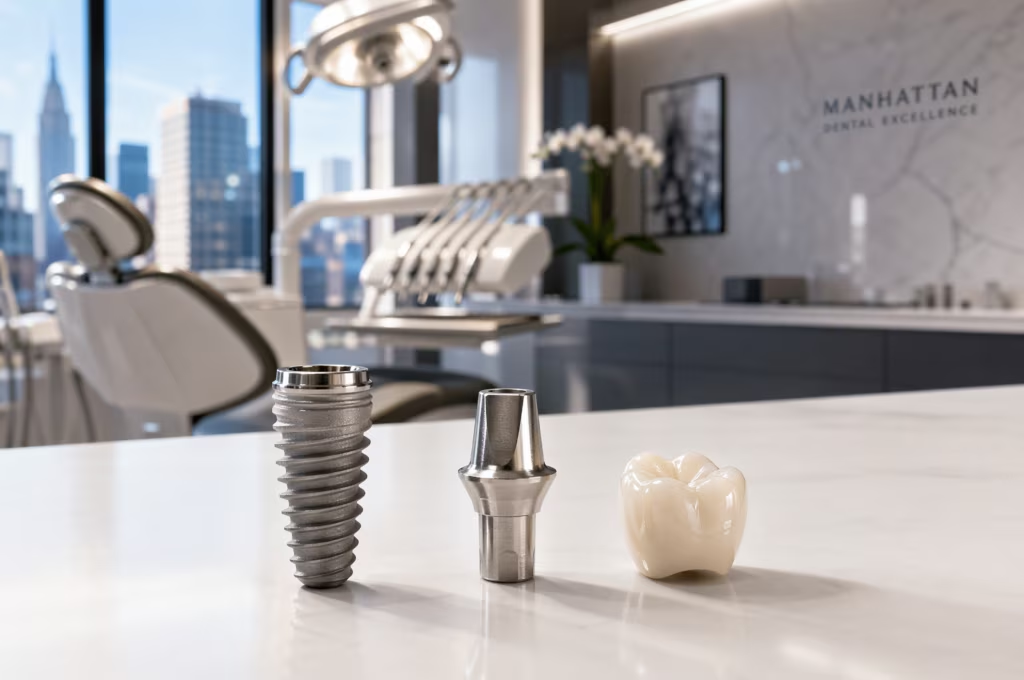
Every dental implant quote hides three distinct price drivers — the post, the abutment, and the crown — and the gap between a $3,500 implant in Walden and a $10,000+ procedure in Midtown Manhattan comes down entirely to what happens at each of those three stages. Two quotes for «the same procedure» can differ by thousands of dollars without anyone lying to you. That’s not a scam — that’s materials, location, and restoration type doing their quiet, expensive work.
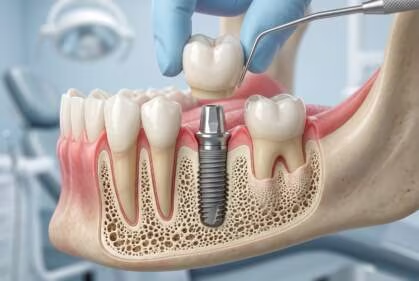
Start with the implant post: the titanium or zirconia screw drilled into your jawbone. In suburban New York, this runs $1,500–$2,500. At a premium Manhattan practice, you’re looking at $3,500 or more before anyone’s touched your mouth. Standard titanium posts — FDA Class II medical devices — carry a 95%+ success rate over a decade, per ADA implantologists. Hard to argue with that track record. Zirconia posts are metal-free, look better near the gumline, and cost roughly 30% more than their titanium equivalents. Then there’s the bone problem: about 40% of NYC patients don’t have sufficient jawbone density for direct placement. Bone augmentation adds $1,000–$3,000 to the bill before the implant itself is even scheduled. The team at 212 Smiling breaks down exactly how these compounding layers — post, abutment, crown, and bridge — stack into real NYC pricing.
The abutment, that small connector between post and crown, adds $650–$950 in most suburban markets. Functional titanium abutments work. Custom zirconia abutments, standard at serious Manhattan clinics for cases in the visible smile zone, cost more — and they look noticeably better. The real sticker shock, though, hits at the restoration stage. A single ceramic crown: $1,100–$2,000. An implant-supported bridge spanning three or more teeth: $3,250 to $30,000, depending on materials and span. Full-arch All-on-4 or All-on-6 systems — increasingly the go-to solution for complete arch replacement heading into 2025–2026 — run $15,000–$31,000 per arch in suburban New York and $25,000–$60,000 in central Manhattan. Still, that represents a 40% savings over replacing every missing tooth individually. Worth the math. The dental implant recovery timeline affects total cost too — immediate-load protocols, now used in roughly 70% of cases, cut down appointment counts and the fees that come with them.
Beyond the three core components, the variables compound fast. Midtown practice overhead — specialist salaries north of $200,000, Manhattan real estate — adds a consistent location surcharge to every quote, no exceptions. Digital planning with 3D CBCT scanning and CAD/CAM fabrication is now effectively standard at reputable clinics, adding around $300 to diagnostics but preventing the kind of alignment errors that cost far more to fix later. Watch the line items other providers bury: extractions ($200–$500), sinus lifts for upper jaw placements, and annual maintenance averaging $500 per year. On insurance: Delta Dental and Cigna typically cover 0–50% with annual caps around $1,500, and most plans quietly exclude the implant post as «cosmetic.» New York Medicaid now covers medically necessary implants for qualifying patients as of 2024 — a real shift. When you’re comparing quotes, demand an itemized breakdown by restoration type and materials across all three components. That single request cuts through every vague estimate and makes the comparison honest.
How do Manhattan, Midtown, and suburban prices compare?
One implant, two zip codes — and suddenly you’re looking at a $3,000 gap: that’s the New York dental implant market in a single sentence. Suburban clinics hover around $3,000 per implant. Cross into prime Manhattan territory and that number climbs past $6,000 without blinking. Why? Layered overhead that has no mercy. Midtown practices absorb some of the most punishing commercial rents on the planet, pay specialist salaries that reflect it, and maintain surgical suites equipped with imaging technology that costs more than most people’s cars. Every dollar of that operational reality flows directly into your treatment invoice.
According to Meridian Dental Group, a complete Midtown case — diagnostics, bone grafting if required, the abutment, the final crown — realistically lands between $5,000 and $8,000 per tooth, sometimes more. Suburban alternatives in Westchester, Long Island, or across the river in New Jersey typically run 20–40% cheaper, because their facility costs and payroll simply aren’t playing in the same league. The catch? Subspecialized oral surgeons and implantologists tend to cluster in urban cores. Distance from those experts is the hidden price of the lower quote.
Specialist access is the part of this equation most patients wave off — and then regret. Manhattan and Midtown clinics routinely keep periodontists, prosthodontists, and maxillofacial surgeons under one roof. Complex, multi-stage cases get coordinated tightly, with no referral lag, no scheduling gaps between providers. Suburban practices often fragment that process across multiple locations and timelines. To see exactly why each procedural stage carries its own cost weight — and how geography shapes that — it’s worth understanding how dental implant surgery actually works in a New York context.
Finding the right clinic match comes down to one honest question: how complicated is your case? A single healthy tooth replacement with solid bone? A well-reviewed suburban practice can save you real money. Full-arch restoration, bone augmentation, same-day implant protocols? The Manhattan price premium tends to pay for itself — through better integration rates, fewer complications, and outcomes that actually hold up over a decade. Geographic location isn’t a footnote in your decision. It’s a variable with consequences. Treat it that way.
How do you estimate your real treatment budget before committing?
When you research dental implants, it is crucial to understand the exact prices involved. Using a pricing guide or reviewing a dental implant cost comparison by city can help, but you must also take specific actions with your chosen clinic to estimate your real treatment budget.
- Request comprehensive 3D scans and initial consultations to ensure accurate diagnostics and avoid unexpected fees.
- Ask for fully itemized quotes that clearly separate the costs of the implant post, abutment, crown, and surgical fees.
- Inquire about available financing terms, flexible payment plans, and what portion your insurance might cover.
- Clarify all long-term maintenance costs upfront, including specialized cleanings, future check-ups, and potential part replacements.
Are All-on-4 and All-on-6 cheaper than replacing each tooth separately?
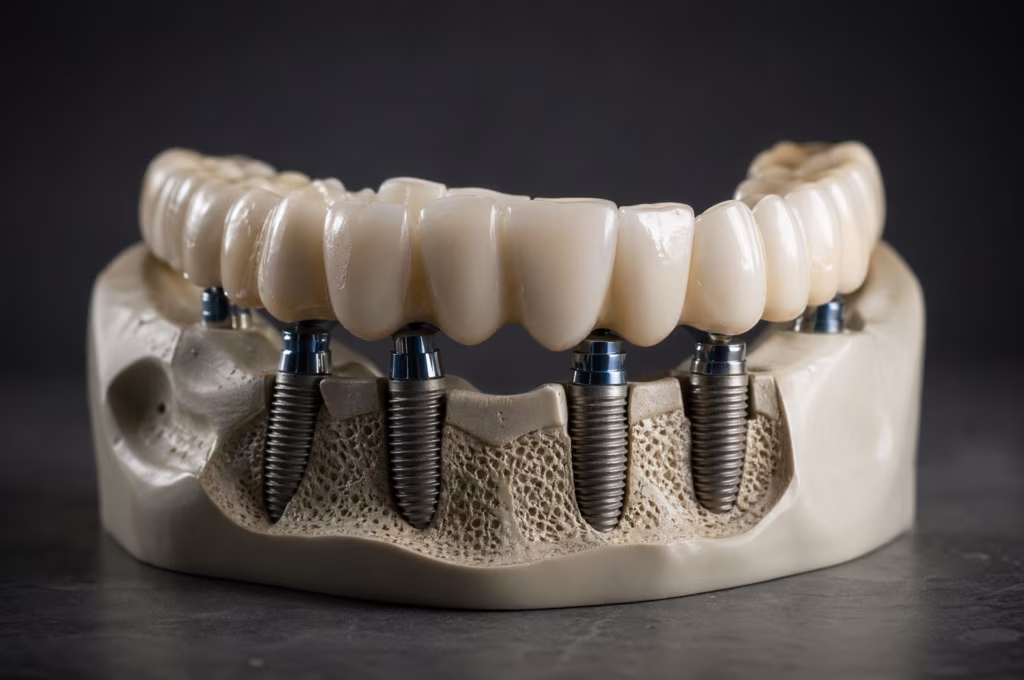
All-on-4 and All-on-6 full-arch implants cut your total bill by 40–50% compared to replacing every tooth one by one — and in New York, that gap runs into the tens of thousands of dollars. Single implants in the metro area run $3,500–$10,000 each. Multiply that across a full arch. The number gets ugly fast. Full-arch solutions collapse the entire reconstruction into one surgical procedure, four or six precisely angled posts, and a single prosthetic fee — no stacking crown costs across years, no repeat anesthesia, no dragging out the process until your patience and your wallet both give out.
At full-arch scale, the math stops being abstract and starts being brutal. Replacing 12–14 teeth individually in New York? You’re looking at $42,000–$140,000 depending on borough and material. A complete All-on-4 in the outer boroughs or suburbs typically runs $15,000–$31,000. Even premium Manhattan practices price full-arch solutions at $25,000–$60,000 per arch — a fraction of what per-tooth treatment costs. Experts at Walden Dental NY put long-term savings at roughly 50% over a 20-year horizon compared to traditional methods. And with immediate-load protocols, many patients walk out of surgery the same day with a fully functional fixed prosthesis. No waiting. No temporaries. Done.
Here’s what most patients don’t think about: the hidden cost of complexity. Every individual implant post is another potential failure point — rejection, peri-implantitis, crown replacement. These costs compound quietly over years. All-on-4 and All-on-6 configurations distribute bite force across fewer anchors more efficiently, reducing per-implant stress. The angled placement technique used in All-on-4 also frequently eliminates the need for bone augmentation — a procedure that would otherwise add $1,000–$3,000 per site. Zirconia prosthetics carry a 30% price premium over acrylic, yes. But they also last 20-plus years. That’s not a cost. That’s an investment with a defined return.
Full-arch solutions aren’t for everyone. If you still have a solid majority of healthy teeth, targeted implants or an implant-supported bridge will likely serve you better — and cheaper. But for anyone facing the loss of most or all teeth in an arch, the consolidated approach of All-on-4 or All-on-6 makes structural financial sense. One healing cycle. Bundled costs. Predictable maintenance around $500 per year. And with CareCredit financing offering 0% interest plans stretched across 12–60 months, this level of treatment is no longer reserved for patients with deep pockets — it’s accessible across the entire New York metropolitan area.
What hidden fees and risks should you ask about first?
Before signing anything, demand a fully itemized cost breakdown from your provider — because the number advertised for dental implants and what you’ll actually pay at the end of treatment are rarely the same figure. The quoted price for a single implant typically covers only the titanium post. Nothing else. Yet the complete procedure almost always pulls in additional components, each billed separately and each capable of quietly inflating your total. An abutment alone adds $650 to $950. A ceramic or zirconia crown tacks on another $1,100 to $2,000. A cone beam CT scan can run $300 or more — and that’s before anyone has even picked up a drill. In New York clinics, these line items are completely standard. Most patients only discover them after signing consent forms.
Jawbone condition is one of the biggest variables affecting both your outcome and your final bill — and it’s consistently underestimated at the consultation stage. Roughly 40% of patients in New York City need some form of bone augmentation before implants can even be placed, which adds $1,000 to $3,000 per site before you’ve gotten to the implant itself. Pre-existing extractions? Another $200 to $500 per tooth. Sinus lifts for upper jaw cases, nerve repositioning, sedation fees — none of these tend to surface in the initial estimate. Ask specifically about revision surgery pricing, too. Poor 3D planning or substandard implant components can cause misalignment severe enough to require corrective procedures costing up to 50% more than the original treatment. And peri-implantitis — inflammation around the implant that affects roughly 15% of cases — can escalate to surgical intervention if ignored. Nobody mentions that at the first appointment.
Long-term maintenance costs are where implant budgets go quietly off the rails. Annual upkeep — professional cleaning, X-rays, bite adjustments — runs around $500 per year. Crowns last 10 to 15 years, meaning replacement costs will land well within the implant’s own lifespan. In high-risk patients — smokers, those with osteoporosis — implant failure rates climb to 5–10%, and a failed implant means paying for extraction, potential bone grafting, and a full reimplantation cycle from scratch. As specialists at 212 Smiling point out, component and bridge pricing structures hide fee areas that patients should clarify upfront — especially when comparing single-implant options against implant-supported bridges for multi-tooth gaps.
Protecting yourself financially starts with one non-negotiable step: get a written treatment plan listing exact prices for every phase — diagnostics, extractions, grafts, the implant post, abutment, crown, and follow-up care. Ask directly whether the clinic uses FDA-approved implant materials and board-certified oral surgeons. Discount providers using imported, low-quality posts carry failure rates up to 20% higher than premium alternatives. That’s not a small margin. Confirm what your dental insurance actually covers — most private plans exclude the implant post entirely as a cosmetic procedure, cap annual reimbursement at $1,500, and typically only pay out for diagnostics or the crown. If you’re considering full-arch solutions like All-on-4, verify upfront whether the quoted figure includes the temporary prosthesis worn during osseointegration — a healing period that takes three to six months — or whether that’s yet another line item waiting to appear on your final invoice.
Which cost factors raise the final bill most often?
When planning for dental implants in New York, the final bill is often influenced by several key cost drivers. Understanding which add-on costs are clinical necessities, such as addressing your jawbone condition, versus optional upgrades like premium materials used or specific restoration types, can help you budget effectively.
| Cost Driver | Category | Description |
|---|---|---|
| Bone Grafting | Clinical Need | Required if the jawbone condition is insufficient to support the implant securely. |
| Zirconia Upgrades | Optional Upgrade | Premium materials used for enhanced aesthetics and durability compared to standard options. |
| Immediate-Load Protocols | Optional Upgrade | Advanced techniques allowing for temporary teeth placement on the same day as surgery. |
| Full-Arch Systems | Restoration Type | Comprehensive solutions like All-on-4, which can be a clinical necessity for full tooth loss. |
| Long-Term Maintenance | Clinical Need | Essential follow-up care, professional cleanings, and potential future adjustments. |
Data source: Midtown Dental Care — Factors influencing Midtown NYC implant costs, including restoration type.
What do experts say about long-term value?
Dental implants are the gold standard for tooth replacement — and every leading expert, from the ADA to board-certified implantologists, will tell you the same thing: a 95% success rate over 10+ years is a benchmark no bridge or denture can touch. When patients start researching their options, the instinct is to compare price tags. Wrong move. The real comparison has to account for the full lifespan of the restoration — not just what you hand over at the front desk on day one.
New York specialists back this up with hard numbers. Practitioners working with All-on-4 systems report that patients choosing implant-supported full-arch restorations can save up to 50% compared to traditional per-tooth replacement — measured over a 20-year horizon. Yes, bone augmentation adds $1,000–$3,000 to the bill, and roughly 40% of NYC patients need it due to lifestyle-related bone loss. But that step directly supports the durability that makes implants worth every dollar in the first place. Premium materials — zirconia abutments, ceramic crowns — push aesthetic and functional longevity even further. Manhattan and Midtown practices see this preference constantly.
According to CareCredit, around 60% of patients finance their implants — which means the gold standard doesn’t have to be out of reach even when per-unit costs run $3,500–$7,500 in suburban New York or climb to $10,000 in Manhattan. Look at it through the lens of total cost of ownership: factor in maintenance, crown replacements at the 10–15 year mark, and the very real cost of adjacent tooth damage that cheaper alternatives quietly cause. Run those numbers. Implants win.
Looking toward 2026, specialists project roughly a 5% price increase driven by labor shortages and materials inflation. But here’s the other side of that equation: AI-driven digital planning and immediate-load protocols are expected to cut procedure time and associated costs by around 10%, with up to 70% of cases moving to these streamlined workflows. The expert consensus doesn’t waver — choose a board-certified oral surgeon or prosthodontist, seriously consider suburban practices for better value, and stop treating implants like a discretionary purchase. They’re a long-term health asset. Full stop.
How do insurance, Medicaid, and financing affect out-of-pocket cost?
Insurance, Medicaid, and financing can slash your dental implant bill — but the fine print will make or break your budget, so read it before you sit in that chair. Most private dental plans label implants as cosmetic or elective, which in practice means one thing: the insurer either walks away entirely or chips in only on the prosthetic crown — typically 50%, with annual caps sitting somewhere between $1,000 and $2,000. A single implant runs $3,000 to $5,000 or more. Do the math. Insurance rarely closes that gap, which is exactly why building a detailed pricing guide before treatment starts isn’t optional — it’s survival.
Here’s what most people miss: medical necessity can unlock coverage that standard dental plans flatly ignore. If tooth loss or jawbone deterioration ties back to a documented medical condition — oral cancer, severe trauma, a congenital defect — part of the procedure may shift to your medical insurance instead. A completely different bucket of money. Medicaid, though? Bleak. Most state programs for adults cover little beyond emergency extractions and bare-bones restorative work, though children under CHIP sometimes get broader dental benefits. The standout exception is VA healthcare — veterans whose tooth loss is service-connected can qualify for implants through one of the few publicly funded pathways that actually delivers meaningful coverage.
When insurance and Medicaid leave you holding the bill, financing converts a gut-punch lump sum into something you can actually manage month to month. As experts at CareCredit point out, pairing financing tools with clear average-cost benchmarks is critical once insurance benefits run dry. Healthcare credit lines like CareCredit or Lending Club Patient Solutions frequently offer promotional 0% APR windows — 12 to 24 months — that eliminate interest entirely if you clear the balance in time. Miss that window and rates spike hard. Many dental offices also run in-house payment plans, sometimes with no credit check at all, spreading costs over 12 to 36 months at low or zero interest.
To actually minimize what comes out of your pocket, stop treating these variables in isolation. Your plan’s explanation of benefits, the annual maximum, and your financing terms are all connected — pull on one and the others shift. Ask your dentist for an itemized pre-treatment estimate that breaks out the implant post, the abutment, and the crown separately. Some plans won’t cover the full procedure but will cover individual components. Combining even partial insurance reimbursement with a 0% financing window is consistently the most effective strategy for making average implant prices bearable — without pushing necessary treatment further down the road.
Mini case: what the solution looks like in a real clinical scenario
One real patient’s case shows exactly how dental implant costs in New York work in practice — and why the fear of «too expensive» almost cost her three years of normal life. Maria, 47, a Brooklyn resident, had been chewing on one side of her mouth since a failed root canal left a gap where her upper molar used to be. Three years of that. She kept postponing treatment, convinced it would drain her savings and consume months of her life. She was wrong on both counts.
Her first move was booking a consultation at a Manhattan implant clinic. Smart move. The team ran a full 3D cone beam scan — not a quick glance at an X-ray, but a proper volumetric assessment of her bone density and jaw structure. Then came the number she’d been dreading: $4,200 total for the implant fixture, abutment, and porcelain crown. For a single-tooth restoration in New York, that sits squarely within the standard range. No hidden fees. No vague estimates. An 18-month zero-interest financing plan broke it into payments that didn’t require any heroic financial decisions. Her insurance even covered a portion of the crown. The math, it turned out, was far less terrifying than the anxiety she’d built around it.
The clinical side was just as straightforward. One surgical appointment — under an hour — to place the titanium implant. Then three to four months of osseointegration: the implant fusing with living bone while Maria wore a temporary restoration and went about her life completely undisrupted. No drama. No downtime. When the implant had fully bonded with the surrounding bone, her custom crown was seated at a brief follow-up visit. The finished result? Indistinguishable from her natural teeth. Fully functional. Done.
At her six-month review, Maria had zero complaints. No sensitivity. No aesthetic issues. No second thoughts. Her story isn’t unique — it’s the standard arc at experienced implant practices across New York: a patient walks in carrying financial anxiety and procedural dread, and walks out with a restoration that holds up for decades. The difference between that outcome and three more years of avoidance? A single honest conversation about costs at the very beginning.
Conclusion
Dental implant prices in New York City are brutally complex — and patients who walk in with realistic expectations consistently come out ahead of those chasing the cheapest number on a flyer. A single implant across the five boroughs runs roughly $3,500 to $10,000+, depending on where you sit geographically, who’s holding the drill, and what materials end up in your jaw. Full-arch solutions like All-on-4? Expect $15,000 to $60,000 per arch, with Manhattan practices anchored firmly at the top of that range — high overhead, premium titanium, and a dense concentration of board-certified oral surgeons don’t come cheap. Know these bands before your first consultation and you won’t flinch at the number. You’ll just ask smarter questions.
That advertised per-implant price? Almost meaningless on its own. Bone grafting quietly adds $1,000–$3,000. A CBCT scan and digital treatment planning tacks on another $300–$500. Extracting a failing tooth before the post even goes in? Another $200–$500. The headline figure is bait. What actually matters is the total treatment cost — itemized, in writing, confirmed to include the post, abutment, and crown as a single bundle. And before you sign anything, ask one more question: what happens financially if peri-implantitis or implant failure shows up during osseointegration? The answer tells you everything about how much a clinic actually stands behind its work.
Suburbs like Walden and the outer boroughs routinely run 30–50% cheaper than Midtown Manhattan, while still operating on FDA-approved implant systems and ADA-compliant surgical protocols. The gap is real. AI-assisted digital planning and immediate-load techniques are expected to trim procedure time and nudge costs down from 2026 onward — even as labor inflation pushes baseline prices up 3–5% annually. Around 60% of implant patients in the New York metro now finance through programs like CareCredit, locking in 0% interest over 12–60 months. Private insurance? It covers anywhere from nothing to 50% of allowable costs, usually capped at $1,500 per year. Plan accordingly.
The path to a clinic you can actually trust runs through board-certified surgeons, transparent all-inclusive quotes, and documented 3D imaging protocols — not through whatever «special offer» is running this month. Implants placed without rigorous pre-surgical planning fail at significantly higher rates, and correcting a botched job can cost more than 50% of what you paid the first time. Done right, implants carry a 95% ten-year success rate and can last well beyond 20 years. In a market as competitive and uneven as New York’s, a methodical, numbers-first approach isn’t overcaution. It’s the only approach that makes sense.
Book a free consultation
Clarify your timeline, exact price, and treatment steps with our experts.
Useful if you want to understand timing, stages, and budget before starting treatment.
Frequently Asked Questions
How much does a dental implant cost in New York?
The cost of a single dental implant in New York typically ranges from $3,000 to $6,000, including the implant post, abutment, and crown. Prices vary depending on the dentist's experience, clinic location, and the complexity of your case.
Why are dental implants more expensive in New York than in other states?
Dental implants in New York tend to cost more due to higher overhead expenses such as office rent, staff salaries, and the overall cost of living. Additionally, many New York specialists maintain advanced certifications and use premium implant materials, which also contribute to higher fees.
Does dental insurance cover implant costs in New York?
Most standard dental insurance plans do not fully cover dental implants, as they are often classified as a cosmetic or elective procedure. However, some plans may cover a portion of the cost, such as the crown or preparatory procedures. It is recommended to check with your insurance provider for specific coverage details.
Are there financing options available for dental implants in New York?
Yes, many dental clinics in New York offer flexible financing options, including monthly payment plans, in-house financing, and third-party services such as CareCredit or Lending Club. These options allow patients to manage the cost of dental implants without paying the full amount upfront.
What factors can affect the total cost of dental implants in New York?
Several factors influence the final price of dental implants in New York, including the number of implants needed, the need for bone grafting or sinus lift procedures, the type and brand of implant used, the dentist's qualifications and location within the city, and any additional restorative or preparatory treatments required.