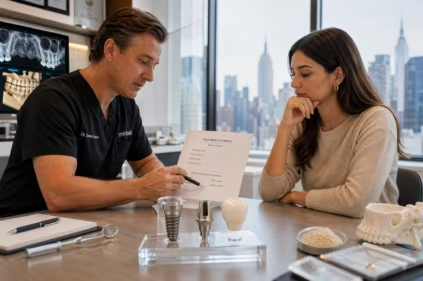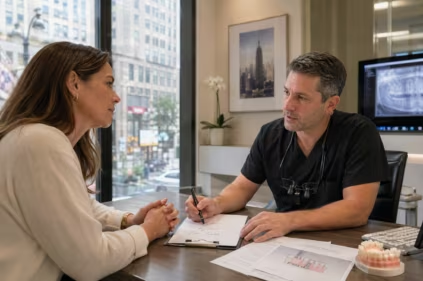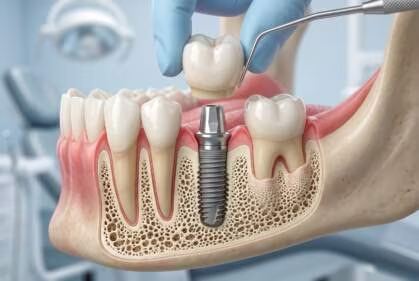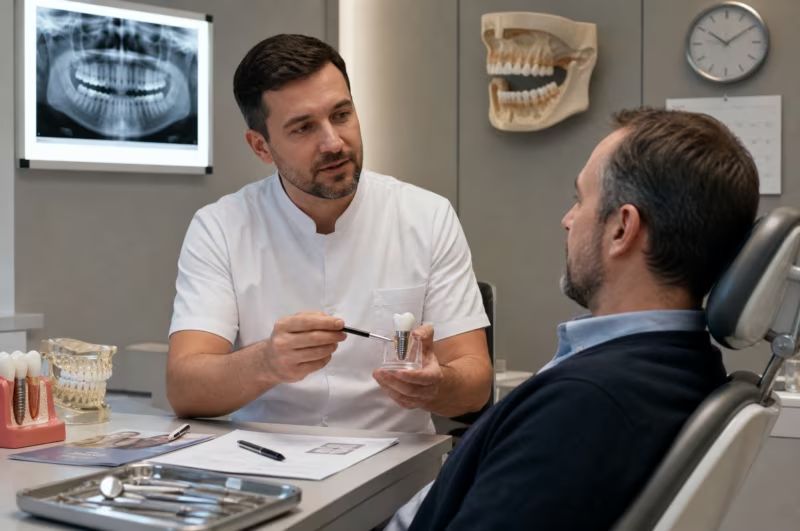
- Диагностика определяет план лечения.
- Приживление импланта занимает несколько месяцев.
- Финальная коронка ставится после стабильного результата.
имплантация зубов в Москве: цены, этапы и сроки обычно проходит поэтапно: сначала диагностика и подготовка, затем установка импланта и только после этого финальное восстановление зуба. Такой маршрут помогает заранее понимать сроки и спокойно планировать лечение.
Contents:
- A clear explanation without unnecessary complexity
- A clear explanation without unnecessary complexity
- Treatment timeline: from diagnosis to final crown
- Treatment timeline: from diagnosis to final crown
- A clear explanation without unnecessary complexity
- A clear explanation without unnecessary complexity
- 3 treatment scenarios: which path fits the clinical situation
- A clear explanation without unnecessary complexity
- A clear explanation without unnecessary complexity
- Mini case: what the solution looks like in a real clinical scenario
- A clear explanation without unnecessary complexity
A clear explanation without unnecessary complexity
When considering dentistry in Moscow, it is important to compare the costs of different implant brands and crown types. The final price depends on whether you choose a standard surgical placement or a comprehensive turnkey implantation package. To better understand the process before reviewing the costs, you can learn about the dental implant stages .
| Implant Brand | Surgery Only | Turnkey Package |
|---|---|---|
| Osstem | 30,000 RUB | from 96,000 RUB |
| Nobel Biocare | 55,000 RUB | Calculated individually |
| Straumann | 65,000 RUB | Calculated individually |
A clear explanation without unnecessary complexity
One dental implant in Moscow — when you add up the brand, the prosthetics, bone condition, anesthesia, and digital planning — will set you back anywhere from 65,000 to 123,000 rubles, and often more. Every cost driver in that range has a logic. Learn it, and you stop taking quotes on faith.
The implant brand is where the math starts. Korean Osstem runs 30,000–36,000 rubles for the surgical fixture alone — the most accessible entry into the serious tier. Swedish Nobel Biocare opens at roughly 55,000 rubles. Swiss Straumann sits at 65,000–69,000. According to Clinica Med, a full turnkey package — implant, abutment, crown — starts from 69,800 rubles, with Osstem anchoring the economy end and Straumann commanding the top. The spread between Korean and Swiss systems reaches 40%. That gap reflects manufacturing costs, years of clinical research, and import logistics. European brands absorbed a further 15% price hike after 2022–2025 sanctions. Korean systems absorbed the demand that followed.
The fixture is just the beginning. A standard metal-ceramic crown adds 15,000–20,000 rubles. Upgrade to zirconia — the aesthetic benchmark now standard across 80% of Moscow clinics, milled via CAD/CAM — and you’re looking at another 10,000–20,000 on top of that. Custom abutments carry their own premium over stock parts. Then comes the wildcard: bone. If jaw volume is insufficient, a sinus lift alone runs 35,000–100,000 rubles. That single line item can double your entire budget without warning. Sedation for anxious patients adds 15,000–25,000 rubles. A CT scan — 3,000–5,000 rubles — is non-negotiable before anyone touches the drill. For the full clinical sequence from first consultation to crown delivery, see как проходит имплантация зубов до коронки.
Digital planning has stopped being a luxury. It’s now a legitimate cost argument. Clinics running 3D CT navigation and surgical guides charge more upfront — but expert data from Akademstom and Sm-stomatology shows 3D-guided placement cuts complication rates by around 30%. A positioning error that needs correcting can cost 50,000 rubles. So the «expensive» clinic may be the cheaper one. By 2026, Osstem is forecast to hold over 50% of the Moscow implant market as digital workflows compress timelines and outcome parity with European systems narrows the perceived premium. One more number worth knowing: Russia’s 13% personal income tax deduction on medical services returns up to 15,600 rubles annually. On a 120,000-ruble all-inclusive case, that brings your net cost down to roughly 104,000 rubles. Factor that in before you decide which brand tier you’re actually shopping.
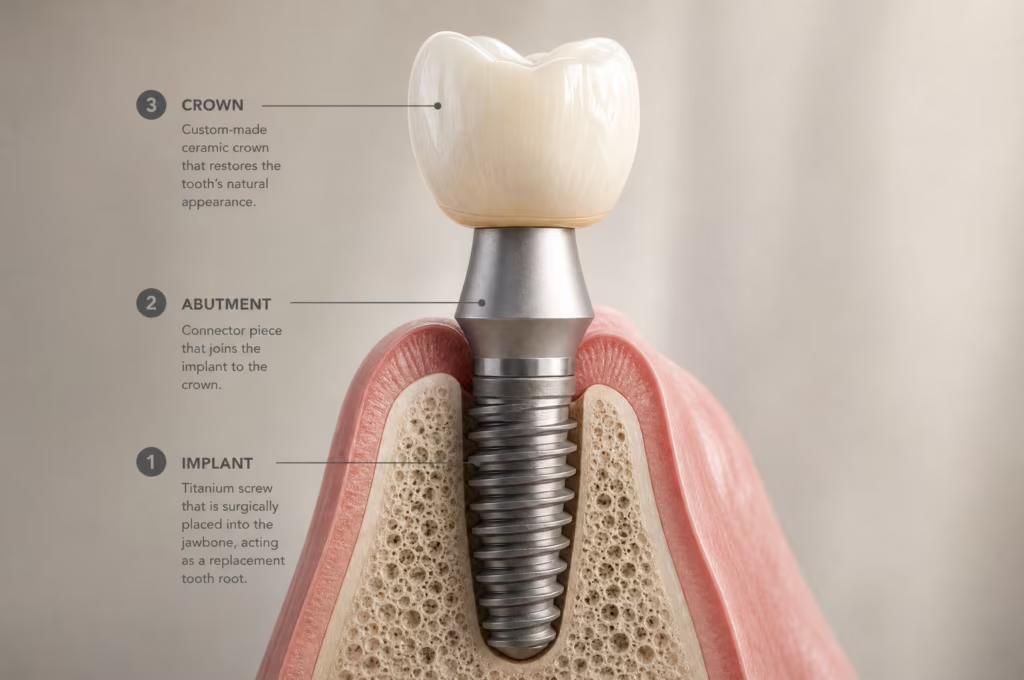
Treatment timeline: from diagnosis to final crown
The journey of dental implantation involves several critical phases to ensure a successful and lasting result. As noted by Systema Clinica, treatment timelines can vary: a two-stage process typically takes 3 to 6 months, whereas a one-stage procedure can be completed in 1 to 2 days.
- Conduct a comprehensive diagnostic evaluation to assess bone density and carefully plan the dental implantation.
- Perform the surgical operation to place the titanium implant securely into the jawbone.
- Monitor the dental implant healing stages to ensure proper osseointegration and tissue recovery.
- Place a temporary crown to restore immediate functionality and aesthetics during the healing period.
- Fix the permanent crown onto the implant, completing the final step for a durable and natural-looking smile.
Treatment timeline: from diagnosis to final crown
Choosing between single-stage and two-stage implantation isn’t a matter of preference — it’s a clinical decision driven by bone volume, soft tissue quality, and the individual patient’s risk profile. The single-stage protocol places the implant and healing abutment in one session. Fewer procedures. Less total chair time. But this efficiency comes with a condition: the patient needs solid bone density, clean periodontal status, and no red flags lurking in the background.
Two-stage implantation is a different philosophy entirely. First surgery goes in beneath the gumline — then the tissue closes over the implant and healing begins undisturbed. Weeks later, a second minor procedure exposes the implant and connects the abutment. According to specialists at SM-Stomatology, in the molar zone this process spans roughly 5–6 months, with each surgical session running 15 to 45 minutes. Not fast. But in cases of uncertain primary stability, simultaneous bone grafting, or a posterior jaw site that simply needs to be left alone — this controlled timeline is exactly the point.
The single-stage route carries a real early-loading risk if osseointegration falters even slightly. Two-stage extends the calendar but gives bone and implant surface the conditions they need to integrate properly. Neither protocol wins on paper. Outcomes hinge on surgical execution, the patient’s systemic health, and how seriously they follow post-operative instructions. Anyone comparing the two pathways should also run the numbers — a thorough financial breakdown is laid out in the guide on dental implant costs.
The final call belongs to the clinician and patient together — made after cone-beam CT imaging and a proper medical history review, not before. Borderline bone quality? Augmentation paired with the two-stage protocol is the evidence-backed default. But a healthy patient with adequate bone in the anterior zone? The single-stage approach cuts the surgical burden significantly — as long as loading is held off until osseointegration is confirmed and stable.
A clear explanation without unnecessary complexity
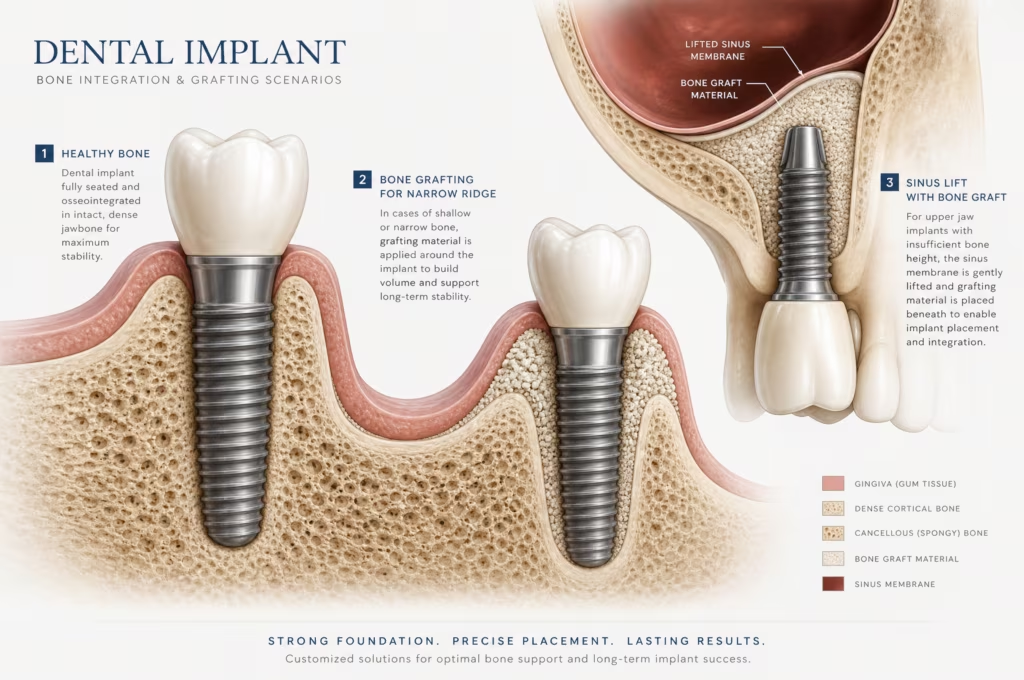
Bone grafting enters the picture the moment your jawbone lacks the volume or density to hold an implant steady — and that single anatomical fact can double your bill and stretch your timeline by half a year. When bone has quietly wasted away after tooth loss, gum disease, or years without a root stimulating natural remodeling, nothing moves forward until the deficiency is fixed. No exceptions. Even the most advanced implant system on the market cannot achieve the primary stability osseointegration demands if the foundation simply isn’t there.
What gets added to your treatment plan depends entirely on how bad the deficit is. Minor shortfalls? Guided bone regeneration (GBR) — a membrane and graft material placed right alongside the implant in a single session. Serious atrophy in the upper jaw is a different story. That typically means a sinus lift: the sinus floor gets elevated to carve out vertical space for the implant. In Moscow’s 2026 market, a sinus lift alone adds 35,000–100,000 rubles to the budget. Then you wait. Four to six months before implant placement can even be scheduled. According to Dmitrovich Clinic, a turnkey Korean-brand implant starts from 65,000 rubles, premium options from 85,000 — but add bone grafting and the total estimate can effectively double. Patients who weren’t told this upfront during consultation find out the hard way.
Think of insufficient bone as a cost multiplier for the entire plan. Industry data is consistent: augmentation inflates the overall budget by 50–100%, depending on volume and technique. The graft material itself — synthetic, xenograft, or harvested from your own chin or hip — the barrier membrane, a follow-up CT scan to verify integration, extended anesthesia. It all stacks. Bilateral sinus lifts or block bone grafts push costs well beyond the base implant price. This, incidentally, is part of why All-on-4 and All-on-5 protocols were developed: by angling implants into anatomically denser regions, they sidestep moderate bone loss entirely, reducing or eliminating the grafting requirement. At 330,000–360,000 rubles per arch, they look expensive — until you price out the alternative for a fully edentulous patient.
Patients with osteoporosis, a history of oncological treatment, or significant resorption from long-term tooth absence face the highest augmentation risk. The implantologists are unambiguous on this: thorough 3D CT diagnostics at the planning stage — not after — is the only way to forecast whether bone grafting will be needed and to quote a realistic total. Clinics that price implants without first analyzing bone volume are the source of the most common complaints in the field. A quoted 25,000–30,000 rubles balloons to 60,000 rubles or more once augmentation gets factored in. Transparent pre-surgical planning, including bone density assessment, protects your budget — and the long-term integrity of the implant itself.
A clear explanation without unnecessary complexity
To cut implant complication rates to single digits, you need four things working in concert: precise 3D treatment planning, ruthless patient selection, protocol tailored to the individual, and hygiene that never slips. Before anyone picks up a drill, a full clinical and radiographic workup is non-negotiable — bone density, volume, anatomical landmarks, all of it mapped through cone-beam CT. Not a panoramic X-ray. Not a clinical guess. A 3D-CT. Skipping it is how preventable failures happen.
Patient selection is where implantology either earns its reputation or destroys it. Absolute contraindications — uncontrolled diabetes, active oncological treatment, severe osteoporosis, recent bisphosphonate therapy — these aren’t negotiable. They must be identified and resolved before a single incision. Relative contraindications are trickier. Smoking, bruxism, chronic poor oral hygiene — each demands its own protocol adjustment. A bruxist, for example, needs a modified loading schedule and solid prosthetic protection, or you’re setting up a slow-motion failure. When you do this screening properly, the implant protocol stops being generic and starts being biological. That precision is what drives complication rates down.
3D-CT pre-surgical planning isn’t a premium add-on. It’s the baseline. Cone-beam CT lets the surgeon virtually seat the implant, check clearance from the inferior alveolar nerve and maxillary sinus, and lock in the optimal diameter and length — all before the first cut. The surgical guide then translates that digital plan into real-world accuracy with zero guesswork. As the specialists at SM-Stomatology point out, two-stage implantation in the molar zone typically runs 15–45 minutes, with a total treatment arc of 5–6 months. That timeline only holds when 3D planning eliminates bone deficiencies and anatomical surprises before they become intraoperative crises.
Long-term survival? It lives or dies on hygiene. Peri-implantitis — the leading cause of late implant loss — is largely preventable. The evidence is unambiguous: patient education from day one, professional maintenance every 3–6 months, proper interdental tools around implant-supported restorations. When all four pillars lock in — comprehensive 3D-CT diagnostics, evidence-based contraindication screening, individually matched protocol, and consistent hygiene discipline — even complex cases land in single-digit complication territory.
3 treatment scenarios: which path fits the clinical situation
Understanding the timeline for dental implants is crucial for planning your treatment. The duration varies significantly depending on the clinical scenario, such as whether a tooth extraction or bone grafting is required.
| Clinical Scenario | Estimated Timeline | Description |
|---|---|---|
| One-stage implantation | 1-2 days | Immediate loading with a temporary crown right after implant placement. |
| Two-stage implantation | 3-6 months | Standard protocol allowing the implant to fully integrate into the bone before loading. |
| Immediate placement after tooth extraction | 3-6 months | The implant is placed directly into the fresh extraction socket, followed by a healing period. |
| Implantation with bone grafting / sinus lift | 6-9 months | Additional time is required for the grafted bone to heal and integrate before or during implant placement. |
| Full-arch protocols (e.g., All-on-4) | 1-7 days | A fixed temporary prosthesis is placed shortly after surgery; final restoration occurs after 3-6 months. |
Data source: Systema Clinica — Сроки: двухэтапная 3-6 мес., одноэтапная 1-2 дня.
A clear explanation without unnecessary complexity
Before you sign anything, have a blunt conversation with your surgeon about four risks that clinics rarely volunteer: implant rejection, peri-implantitis, nerve damage, and the warranty gap between the titanium post and the crown sitting on top of it. Rejection hits 3–10% of patients — and that number climbs fast if you smoke or live with diabetes or osteoporosis. The body sends clear signals: persistent pain, swelling, an implant that moves when it shouldn’t. These signs usually surface within the first one to three months. Miss them, and you’re looking at a failed procedure that costs as much to fix as it did to place. Peri-implantitis — a bacterial infection eating away at the tissue around the implant — is even more insidious. It strikes 10–15% of cases, sometimes years after a surgery that looked like a textbook success. Skipped follow-ups and inconsistent brushing are all it takes.
Nerve complications deserve their own conversation, not a footnote. Temporary or permanent numbness of the lip or chin — caused by working too close to the inferior alveolar nerve — shows up in 1–5% of lower-jaw cases. That probability drops sharply when the clinic uses 3D CT planning and surgical navigation guides. So ask, directly: is digital planning included in your quote, or is it an upsell? And push for the surgeon’s annual case volume. Clinics doing fewer than 500 implants a year show statistically higher complication rates. Numbers don’t lie. One more thing: overloading the implant — slapping a permanent crown on before osseointegration is complete, which takes three to six months — is one of the most preventable causes of early failure. Entirely avoidable. Ask whether the protocol respects that window.
The warranty confusion is where post-treatment disputes are born. Patients hear lifetime guarantee and assume it covers everything. It doesn’t. Implant manufacturers back their titanium fixtures for 5–10 years — some premium brands do offer a true lifetime warranty on the post itself — but the crown? Porcelain-fused-to-metal or zirconia crowns carry warranties of just 1–2 years. Many clinics bury this distinction in contract language no one reads at the signing table. Before you leave the consultation, get written documentation: what each warranty actually covers, what voids it (smoking, missed check-ups, trauma), and who pays for a replacement crown if the post is still perfectly intact when the ceramic fails.
Financial surprises are the final landmine. Bone grafting — which can double your entire budget — is sometimes mentioned only after CT imaging is done, when you’re already invested and feel trapped. Sinus lift procedures add 35,000–100,000 RUB. Sedation anesthesia tacks on another 15,000–20,000 RUB. A clinic worth trusting itemizes all of this before treatment starts, not after. Ask your surgeon for a realistic worst-case budget: grafting, extended healing with temporary prosthetics, and the cost of surgical retreatment if peri-implantitis develops. That conversation takes fifteen minutes. Skipping it can cost you months of stress and a second round of surgery bills.
A clear explanation without unnecessary complexity
Before trusting any Moscow dental clinic with an implant, check three things without exception: valid license, surgeon’s credentials, and a written treatment plan with real numbers. Under Federal Law No. 323-FZ and Ministry of Health Order No. 183n, every clinic doing surgical implantation must hold a current Roszdravnadzor license covering surgical dentistry — and anesthesiology if sedation is on the table. Don’t take their word for it. Ask to see the certificate. Reputable clinics keep it on the wall for a reason. The implantologist needs a valid specialist certificate in surgical dentistry or maxillofacial surgery, renewed every five years. And the implant system itself — Osstem, Straumann, Nobel Biocare, whatever they’re proposing — must be registered as a medical device and carry a valid EAEU Declaration of Conformity (TR TS 010/2011). If the clinic can’t produce that on request, walk out.
The diagnostic phase is where clinics separate themselves — or expose themselves. No 3D cone-beam CT scan means no serious surgeon. Full stop. A proper CBCT (budget roughly 3,000–5,000 RUB) lets the surgeon map bone volume, locate the sinus floor, identify the inferior alveolar nerve, and plan exact implant positioning before anyone picks up a drill. Clinics that cut corners with orthopantomography alone are gambling with your anatomy. Mispositioning that requires corrective re-implantation? That’s 50,000 RUB or more added to your bill — not theirs. Experts from Akademstom and SM-Stomatology have consistently documented that 3D-guided planning reduces surgical complications by roughly 30%. The CT data must translate into a full treatment plan handed to you before you sign anything: implant brand, dimensions, whether bone grafting or a sinus lift is needed, crown type (metal-ceramic vs. zirconia), the staged timeline, and a complete itemized cost breakdown.
Now read the contract like you’re signing a mortgage. Informed consent form 309/u is legally mandatory — it must explicitly name the real risks: implant rejection runs 3–10%, infection is a documented possibility, nerve involvement can happen. That’s not fine print, that’s your right to know. Beyond consent, pin down exactly what the warranty covers. Leading-brand implants typically carry a 5–10-year manufacturer guarantee. Crowns? Often just 1–2 years. That gap needs to be in writing, not glossed over in a sales pitch. The itemized estimate must break out every single line: implant and surgery, abutment, temporary crown, permanent crown, diagnostics, extractions if needed, anesthesia type, and any anticipated bone augmentation. «Implant turnkey from 25,000 RUB» — that headline omits the abutment, the crown, and the diagnostics. Realistic all-inclusive costs in Moscow in 2026 start from around 65,000 RUB for Korean-brand systems, and from 85,000–107,000 RUB for premium Swiss or Swedish options.
Last — look at the clinic’s actual track record, not just the brochure. Facilities doing more than 500 implant procedures annually with documented case portfolios are operating at scale for a reason. CAD/CAM technology for individualized abutments and zirconia crowns is now standard across roughly 80% of Moscow implantology centers — its absence is a red flag. Confirm that follow-up imaging and suture removal are included in the package price, and that the clinic has a concrete protocol for periimplantitis, which affects 10–15% of cases over time. One more thing most patients miss: Russia’s 13% personal income tax deduction applies to dental treatment costs up to 120,000 RUB per year. Get the payment receipt and the справка об оплате at settlement — not later, not after a follow-up call. Right then. That documentation is your money back from the state, and the clinic has no reason not to give it to you on the spot.
Mini case: what the solution looks like in a real clinical scenario
This is what dental implantation in Moscow actually looks like — not in a brochure, but in real life, with a real patient and real numbers. A 47-year-old woman. Upper left molar gone, eaten by advanced periodontitis. Two years of avoidance — two years of telling herself she’d «look into it later,» mostly because nobody could give her a straight answer on cost or timeline. When she finally sat in the chair, the examination showed something unusually forgiving: bone density intact, no augmentation needed. Single-stage protocol. They got to work.
First appointment: titanium implant placed under local anesthesia, healing abutment installed at the same visit. The whole surgical part took under an hour. Then came the wait — 8 weeks of osseointegration. No drama, no significant discomfort, no disruption to daily life. Just biology doing its job. When people ask about dental implantation in Moscow — prices, stages, how long it actually takes — this case is the clean version: no bone grafting, no sinus lift, no curveballs. One tooth, one implant, one straightforward path. Total cost landed in the mid-range for Moscow: roughly 45,000–60,000 RUB for the full package — implant, abutment, porcelain crown.
Week ten: impressions for a custom ceramic crown. Week twelve: crown fitted. Full chewing function restored. Zero aesthetic complaints. Start to finish — just under three months. That’s the standard window for single-implant cases in Moscow clinics when no preparatory surgery is involved. Add bone grafting or a sinus lift, and that same timeline stretches to six to twelve months. The cost scales accordingly.
What this case really shows is something surgeons repeat constantly but patients rarely absorb until they’re sitting across from a treatment plan: the total cost and duration of dental implantation in Moscow trace almost entirely back to your clinical starting point. Move early — before the bone starts resorbing — and you’re looking at shorter timelines, lower complexity, and better outcomes. This patient waited two years and still got lucky. Her bone volume held. That’s not a strategy. That’s anatomy being generous. Don’t count on it twice.
A clear explanation without unnecessary complexity
What you actually pay for a dental implant in Moscow comes down to four hard variables: protocol, bone volume, implant brand, and whether your clinic hands you a real treatment plan — or a decoy price. In 2026, a complete turnkey package — implant, abutment, crown — runs 65,000 to 123,000 RUB depending on those variables. Korean Osstem starts around 30,000 RUB for the surgical component. Swiss Straumann? Budget 65,000 RUB and up, just for starters. The spread is not random. It tells you exactly where to look when comparing clinics.
Timelines vary just as sharply. Single-stage immediate-load protocols — now the default at most Moscow practices — can seat a temporary crown the same day as surgery. One visit. Maybe two. That works beautifully when bone density cooperates. For molar zones, where osseointegration failure rates climb, classical two-stage protocols still make sense: three to six months of healing, no shortcuts. Then there are the surprises nobody wants. Sinus lifting runs 35,000–100,000 RUB. Bone grafting can nearly double your final bill. Both are entirely foreseeable — if someone bothers to look. A 3D CT scan costs 3,000–5,000 RUB and eliminates that category of surprise entirely. It is not a luxury. It is insurance against a much larger invoice. Stomatmos currently quotes Osstem at 30,000 RUB, Nobel Biocare at 55,000 RUB, and Straumann turnkey from 96,000 RUB — which shows, clearly, how much brand choice alone moves the final number.
The macro picture has shifted too. Import sanctions pushed European implant prices up roughly 15%, and the market responded fast: Korean and Italian systems now account for over half of all Moscow placements. Year-on-year inflation in this segment runs 7–10%, which means any quote from 2024 is already outdated. One lever works in the patient’s favor, though. Russian tax law permits a 13% personal income tax deduction on medical expenses up to 120,000 RUB per year. On a 100,000 RUB procedure, that brings your net cost to 87,000 RUB. Not nothing. Worth calculating before you sign.
The pattern across patient complaints and clinical audits points in one direction. Low headline prices hide supplementary costs. Clinics running 500-plus implant placements annually — with documented 3D-guided surgical workflows — produce measurably fewer complications and far fewer corrective procedures. Before you agree to anything: demand a fully itemized treatment plan. Every line item, every contingency. That document is the only reliable signal that the quoted price and the final bill will match.
Book a Free Consultation
Get a clear treatment plan, timelines, and cost estimates.
Useful if you want to understand timing, stages, and budget before starting treatment.
Frequently Asked Questions
How much does dental implant treatment cost in Moscow?
The cost of dental implantation in Moscow varies widely depending on the clinic, implant brand, and complexity of the case. A single implant (including the post, abutment, and crown) typically ranges from 30,000 to 120,000 RUB. Budget clinics may offer lower prices, while premium centers with European or American implant systems charge more. Always request an itemized estimate that covers all stages.
What are the main stages of dental implant placement?
Dental implantation in Moscow generally follows these steps: (1) Initial consultation and diagnostics, including 3D CT scanning; (2) treatment planning and, if needed, preparatory procedures such as bone grafting or tooth extraction; (3) surgical placement of the titanium implant post into the jawbone; (4) osseointegration — a healing period during which the implant fuses with the bone; (5) attachment of the abutment; and (6) fitting and fixing the permanent crown.
How long does the entire implant process take?
The total timeline depends on the patient's bone density and whether additional procedures are required. In straightforward cases, the process takes 3 to 6 months — mostly waiting for osseointegration. If bone augmentation is necessary, the timeline can extend to 9–12 months. Some Moscow clinics offer express or immediate-loading protocols where a temporary crown is placed on the same day as implant surgery.
Is dental implantation painful, and what anesthesia is used?
The surgical procedure is performed under local anesthesia, so patients feel pressure but not pain during the operation. Post-operative discomfort, mild swelling, and soreness are normal for a few days and are managed with prescribed analgesics. Many Moscow clinics also offer sedation or general anesthesia for anxious patients, though this increases overall cost.
What should I look for when choosing an implant clinic in Moscow?
Key factors include: the qualifications and experience of the implantologist, the implant systems used (well-known brands such as Straumann, Nobel Biocare, or Osstem carry strong track records), availability of in-house 3D diagnostics, clinic accreditation, warranty terms on implants and prosthetics, and transparent pricing. Reading verified patient reviews and requesting a free initial consultation to discuss your specific case are also strongly recommended.